

Single Poor Property Decision Costs $30,000+ More Than Annual Analytics Subscription, HtAG Analysis Shows
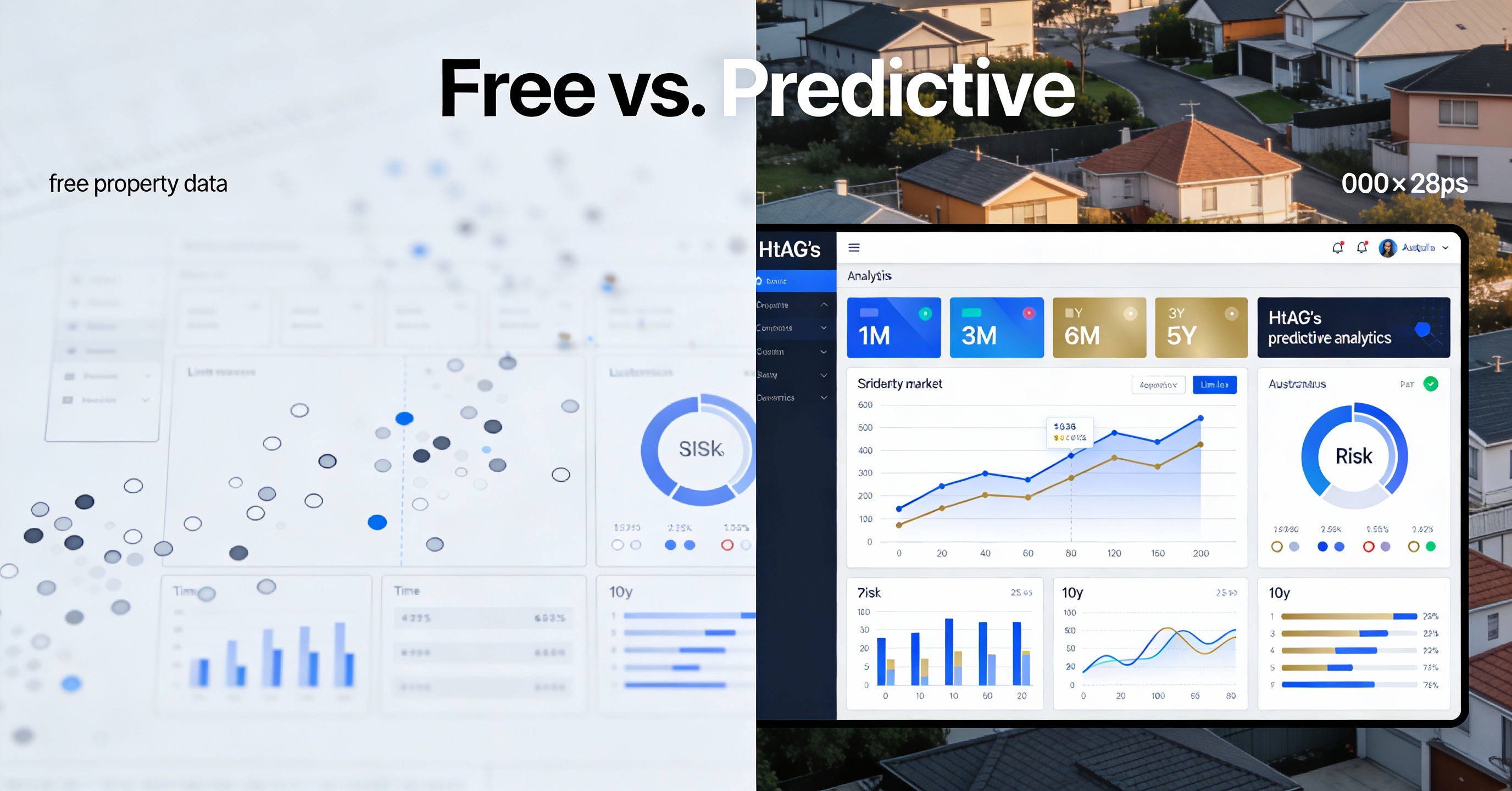
Free vs. Predictive Analytics Comparison
New analysis reveals free property data costs investors $25K-$50K annually in missed opportunities and poor decisions versus data-driven alternatives.
SYDNEY, NSW, AUSTRALIA, January 14, 2026 /EINPresswire.com/ -- HtAG today released a comprehensive analysis demonstrating why free property data platforms are fundamentally unsuitable for serious investment decision-making. The comparison reveals that relying on free sources can quietly cost investors $25,000–$50,000 annually through missed opportunities, poor timing, and unmanaged risk exposure.THE PROBLEM: DESCRIPTIVE DATA, NOT PREDICTIVE INTELLIGENCE
Free property data platforms serve casual browsers well, but they fail investors. Most provide only descriptive analytics—telling users what the market looked like yesterday, not where it is headed tomorrow.
"Free property data stops at the past," explains HtAG's analysis. "Free platforms show median prices, recent sales, and maybe a rental estimate. What they don't show is price growth trajectories, rental yield trends, supply-demand imbalances, or risk factors. That's where serious money is lost."
The research identifies four critical gaps in free property data:
1. Zero Growth Visibility Across Time Horizons
Free tools rarely display 1-month, 3-month, 6-month, 1-year, 3-year, 5-year, or 10-year price and rent growth metrics. Without this data, investors cannot identify emerging markets or avoid declining ones until too late.
2. Incomplete Market Pressure Indicators
While free platforms may show basic supply metrics, they lack critical signals including auction clearance rates, vendor discounting trends, days-on-rental-market data, and market hold periods that reveal whether conditions favor buyers or sellers.
3. No Demand-Side Validation
Free sources provide no insight into consumer search behavior, preventing investors from correlating hypotheses with actual market demand before committing capital.
4. Surface-Level Risk Assessment
Without demographic data, socio-economic indices, hazard risk mapping, or forecast accuracy metrics, investors cannot properly evaluate market volatility or long-term stability.
THE FINANCIAL IMPACT: "FREE" COSTS THOUSANDS
HtAG's analysis quantifies the true cost of incomplete data:
• Missing early-stage growth identification: Entering an emerging market 6–18 months late on a $600,000 investment costs approximately $30,000 in first-year appreciation alone.
• Buying at market peaks: Without growth-cycle analysis, investors risk purchasing near market tops, leading to years of flat or negative returns—a far greater cost than any subscription fee.
• Rental yield miscalculation: Failing to detect rising vacancy rates or slowing rent growth before investing can reduce cash flow by 1–2% annually ($5,000–$10,000 on typical properties).
• Unmanaged risk exposure: Ignoring climate risk, economic concentration, or demographic factors can lead to unexpected volatility and depreciation.
A single poorly timed property purchase—entering a declining market or misjudging rental yield—can erase years of subscription costs.
HTAG'S SOLUTION: PREDICTIVE ANALYTICS AT SCALE
Unlike free platforms, HtAG integrates predictive analytics, machine learning, and advanced data science to transform raw property data into actionable investment intelligence.
HtAG's paid platform delivers:
• Multi-horizon growth metrics: 1-month through 10-year price, rent, and yield growth trajectories—enabling early identification of market momentum.
• Demand and supply indicators: Buy Search Index, Rent Search Index, building approvals, and inventory forecasts that reveal market pressure before it manifests in prices.
• Predictive forecasting models: 2-year capital growth forecasts, rent increase projections, and ROI estimates powered by machine learning and time-series analysis.
• Risk-adjusted composite scoring: Component scores for capital growth, cashflow potential, and risk mitigation, supported by hazard mapping and socio-economic indices.
• Comparative market analysis: 80+ metrics enabling side-by-side market comparison across suburbs, property types, and investment strategies.
• Trend slope analysis: Long-term and short-term velocity measures identifying whether markets are accelerating, decelerating, or stagnating.
These capabilities reflect standard data science techniques—regression models, decision trees, neural networks, and time-series forecasting—used by professional investors and institutional funds to drive allocation decisions.
WHY PROFESSIONAL INVESTORS NO LONGER USE FREE DATA
As property investment has professionalized, data requirements have evolved. Property professionals—buyer's agents, portfolio managers, development companies, and financial advisors—now treat predictive analytics as non-negotiable.
Free data places all users in the same information pool: reactive, backward-looking, and constrained to current-market visibility. Professionals using HtAG operate like data scientists of the property market, making decisions grounded in evidence rather than anecdote.
The competitive advantage is significant. Those who spot emerging markets months before others, avoid peak-market entries, and optimize for risk-adjusted returns outperform those relying on free sources by substantial margins.
WHEN FREE DATA IS SUFFICIENT—AND WHEN IT IS NOT
HtAG acknowledges that free property data is appropriate in limited cases: casual market exploration, rough valuations for personal interest, or early-stage research before engaging professionals.
However, free data becomes untenable for:
• Property investment planning within 6–12 months
• Multi-property portfolio management
• Professional advisory roles
• Development or fund management decisions
• Any scenario where capital allocation exceeds $300,000
In these cases, the opportunity cost and risk of incomplete information vastly exceeds subscription fees.
INDUSTRY SHIFT TOWARD DATA-DRIVEN DECISION MAKING
The analysis reflects a broader market shift. As property markets become increasingly competitive and complex, investors who rely on free, surface-level data lose competitive positioning to those equipped with predictive intelligence.
"The question is no longer 'Why pay for property data?'" HtAG notes. "It's 'How much will it cost if you don't?' One misjudged market or poorly timed purchase can erase years of subscription costs in a single transaction."
CONCLUSION
Free property data is designed for browsing, not investing. Serious property investors require comprehensive, predictive analytics platforms that reveal not just what markets are, but where they are headed—and why.
HtAG's analysis demonstrates that the gap between free data and professional-grade analytics isn't merely about quantity of information; it's about the difference between reacting to markets and predicting them.
For investors building long-term wealth through property, that difference is worth far more than the cost of subscription.
About HtAG
HtAG provides predictive analytics and comprehensive property data to Australian property investors, advisors, and professionals. Using machine learning, statistical modeling, and advanced data science, HtAG transforms raw property information into actionable investment intelligence.
For more information, visit www.htag.com.au
Media Contact
Matija (Mat) Djolic
CEO of HTAG Analytics
mat.djolic@htag.com.au
+61407259833
Mat Djolic
HtAG Analytics
+ +61407259833
email us here
Visit us on social media:
LinkedIn
Instagram
Facebook
YouTube
TikTok
X
Legal Disclaimer:
EIN Presswire provides this news content "as is" without warranty of any kind. We do not accept any responsibility or liability for the accuracy, content, images, videos, licenses, completeness, legality, or reliability of the information contained in this article. If you have any complaints or copyright issues related to this article, kindly contact the author above.
