

Chloromethane Market Forecast 2026-2036: Market to Reach USD 10.1 billion by 2035 at a 5.20% by 2036
Chloromethane Market
Chloromethane Market is Segmented By Product, By Application, By End Use
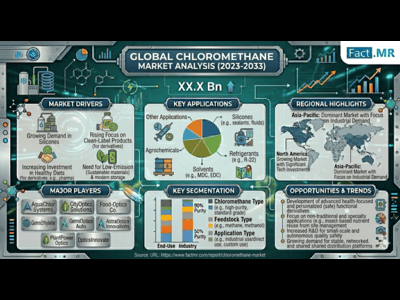
ROCKVILLE, MD, UNITED STATES, March 24, 2026 /EINPresswire.com/ -- The global chloromethane market is undergoing a significant structural evolution, projected to climb from a USD 6.0 billion valuation in 2025 to USD 10.1 billion by 2035. According to a definitive industry analysis by Fact.MR, the sector is expanding at a steady 5.2% CAGR, underpinned by an insatiable industrial appetite for silicone polymers and active pharmaceutical ingredients (APIs).While the industry navigates a complex web of environmental mandates—including the Montreal and Kyoto Protocol phase-outs—demand remains resilient. The surge is primarily anchored by the versatility of methyl chloride, a critical intermediate that has become indispensable to the electronics, construction, and personal care sectors.
Get Access Report Sample :
https://www.factmr.com/connectus/sample?flag=S&rep_id=7397
Strategic Drivers: The Silicone and Pharma Convergence
The market’s momentum is currently dictated by three high-impact growth engines:
The Silicone Boom: Silicone polymers, growing at a 1% CAGR, are the primary application for chloromethanes. These materials are prized for their thermal stability and water repellency, essential for next-generation electric vehicle (EV) components and sustainable construction sealants.
Pharmaceutical Vitality: The pharmaceutical segment, expanding at 4% CAGR, utilizes chloromethane derivatives as fundamental building blocks for APIs. From pain management to oncology therapies, the industry’s reliance on high-purity intermediates is at an all-time high.
Agricultural Modernization: In the agrochemical sector, chloromethanes are vital in the synthesis of herbicides and pesticides, supporting global food security initiatives in rapidly developing economies.
Regional Powerhouses: The Asia-Pacific Ascent
The center of gravity for the chemical industry continues to shift eastward, with India and China leading the charge in both production capacity and domestic consumption.
Country/Region
Forecast CAGR (2025–2035)
Key Growth Catalyst
India
Highest Growth
Rapid industrialization and a booming domestic electronics manufacturing base.
China
9.2% (Estimated)
Massive investments in R&D and a strategic push for self-reliance in chemical feedstocks.
USA
5.1%
Dominance in silicone polymer innovation and high-value pharmaceutical exports.
Germany
13.2% (Segmented)
Leading the transition toward "Industry 4.0" and low-emission chlorination tech.
In the USA, the market is heavily influenced by the demand for lightweight, high-performance materials in the automotive and aerospace sectors. Meanwhile, the Australia-New Zealand region is carving a niche in sustainable pharmaceutical R&D, favoring greener chemical intermediates.
Competitive Landscape: The Titan Moats of Scale and Tech
The chloromethane sector is dominated by a few global giants that have successfully integrated their supply chains to hedge against raw material volatility.
Key Companies Profiled: AkzoNobel N.V., KEM ONE, Shin-Etsu Chemical Co., Gujarat Alkalies and Chemical Limited (GACL), INEOS Group, Solvay, Occidental Petroleum Corporation, Gujarat Fluorochemicals Ltd., The Sanmar Group, SRF Limited, Alfa Aesar, Tokuyama Corporation, AGC Chemicals, Tokyo Chemical Industry.
Market Leaders at a Glance:
INEOS Group (18-20% Share): Commands the market through massive global production capacity and a focus on scalable, sustainable processes.
AkzoNobel N.V. (15-18% Share): A leader in green chemistry, focusing on low-emission technologies that align with stringent EU environmental standards.
Shin-Etsu Chemical (12-14% Share): Dominates the Asia-Pacific region by leveraging a vertically integrated supply chain for specialty electronics and pharma.
Analyst Insights: The "Green" Imperative
"We are seeing a clear divide in the market," says a lead consultant at Fact.MR. "In developed economies, success is defined by regulatory compliance and VOC management. In emerging markets, it's about sheer scale. The winners of the next decade will be those who can bridge this gap by deploying 'closed-loop' manufacturing technologies that reduce environmental impact without sacrificing the cost-efficiency that makes chloromethanes so attractive."
The "Boardroom" Watchlist:
Innovation: Transitioning to low-emission chlorination technology is no longer optional; it is a prerequisite for market entry in North America and Europe.
M&A Activity: Expect increased acquisitions of specialty chemical startups that offer bio-based alternatives or circular economy solutions for chlorinated methane recovery.
ESG Capital: Investors are increasingly favoring companies with high-quality sustainability scores, potentially lowering the cost of capital for green-certified producers.
Browse Full Report –
https://www.factmr.com/report/chloromethane-market
To View Related Report:
Magnesium Nitrate Hexahydrate Market https://www.factmr.com/report/913/magnesium-nitrate-hexahydrate-market
Fuel Injector Cleaner Market https://www.factmr.com/report/766/fuel-injector-cleaner-market
N-Propyl Bromide Market https://www.factmr.com/report/589/n-propyl-bromide-market
Heat Stabilizers Market https://www.factmr.com/report/heat-stabilizers-market
S. N. Jha
Fact.MR
+1 628-251-1583
email us here
Legal Disclaimer:
EIN Presswire provides this news content "as is" without warranty of any kind. We do not accept any responsibility or liability for the accuracy, content, images, videos, licenses, completeness, legality, or reliability of the information contained in this article. If you have any complaints or copyright issues related to this article, kindly contact the author above.
