

Microsoft Fabric and Power BI Deployments Face ETL Breakage from Dataflow Gen1 Retirement, EPC Group Warns
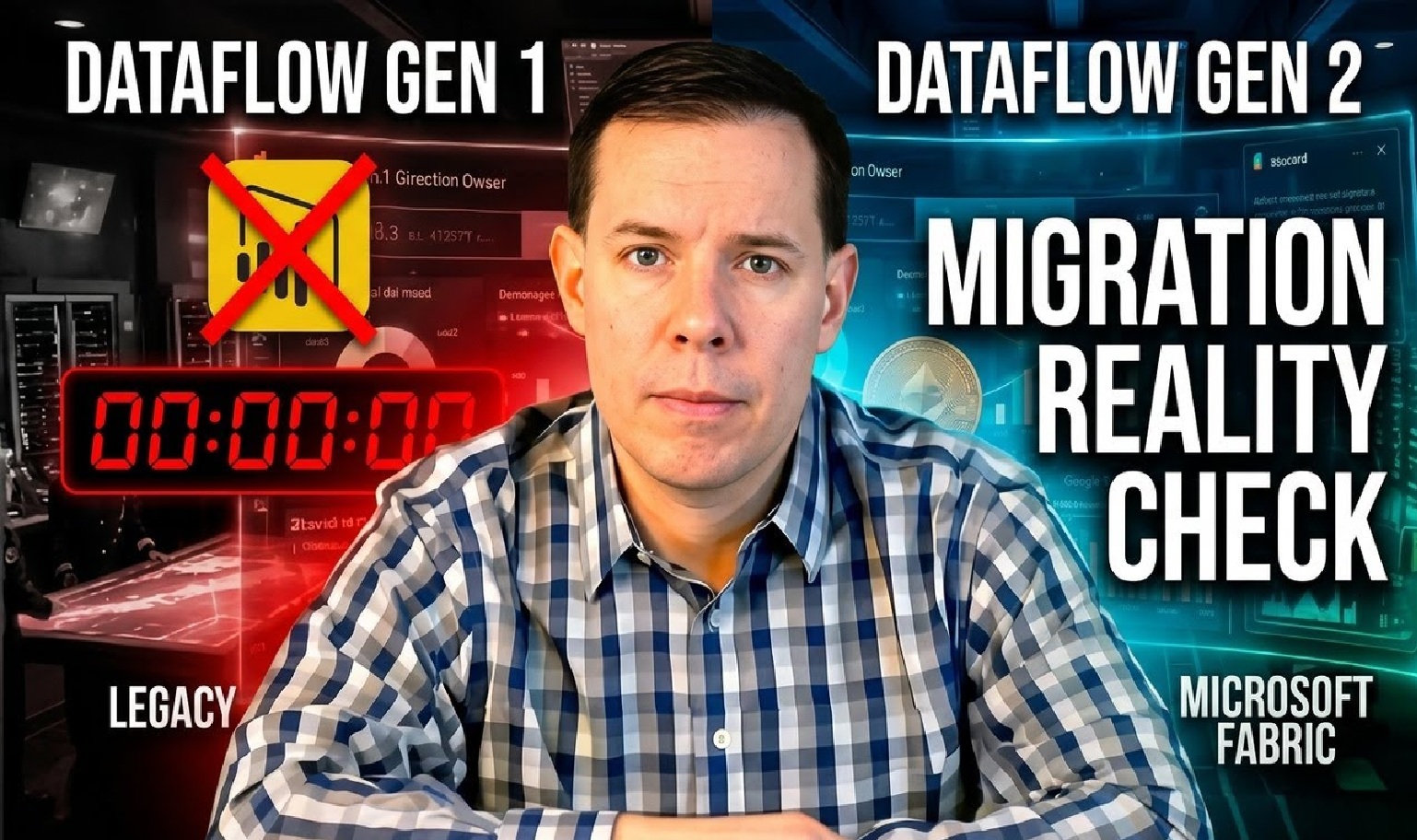
Microsoft Fabric and Power BI Deployments Face ETL Breakage from Dataflow Gen1 Retirement, EPC Group Warns
Virtual Chief AI Officer (vCAIO) service - The First In the Industry - EPC Group's AI Consulting Services
Power BI + AI Done Right: The $50 Million Integration Opportunity
As Microsoft retires Dataflow Gen1, enterprises risk broken ETL pipelines, failed refreshes, and reporting disruption across Fabric and Power BI environments
For many organizations, Dataflow Gen1 has served as a foundational transformation layer inside broader Power BI and Azure‑based analytics architectures. When that legacy layer is retired, teams that have not documented dependencies, rebuilt transformation logic, or mapped downstream semantic model impacts may face failed data refreshes, broken ETL chains, reporting delays, and expensive emergency remediation projects.
EPC Group’s April 2026 planning and lead analysis found that a significant share of new enterprise requests involve Microsoft Fabric migration, Dataflow Gen1 modernization, report sprawl remediation and Power BI governance. Organizations are asking for help simplifying bloated dataflows, consolidating overlapping ETL pipelines, and introducing stronger governance into enterprise analytics.
“Organizations often underestimate how many executive dashboards, operational reports, and semantic models sit downstream from a single ETL layer,” said Errin O’Connor, Founder at EPC Group. “When Dataflow Gen1 is retired the issue is not isolated to one pipeline. It can ripple across Fabric, Power BI business decision‑making if it is not handled as a structured migration.”
What Microsoft Dataflow Gen1 retirement puts at risk
In typical architectures, Dataflow Gen1 pipelines sit at the base of a three‑layer stack: source extraction, transformation and staging, and semantic model delivery into Power BI. As support is removed and Gen1 workloads are deprecated, organizations that rely on that stack face:
● Scheduled data refresh failures across Power BI reports and dashboards connected to Gen1 dataflows.
● Loss of incremental refresh configurations and refresh reliability tied to Gen1’s scheduling and execution model.
● Broken ETL pipelines where Gen1 was used as the primary transformation layer feeding Azure SQL, OneLake, or Fabric Lakehouses.
● Compounding technical debt for teams that have layered redundant dataflows on top of each other over many years without documentation or governance.
EPC Group’s Microsoft Fabric consulting practice has now completed more than 500 Microsoft Fabric implementations & has developed a structured Gen1 migration playbook that maps sources, documents transformation logic, rebuilds pipelines in Dataflow Gen2 or Fabric Data Pipelines & validates Power BI semantic model continuity before cutover.
The broader Microsoft Fabric and Power BI opportunity:
● Fabric and modern Power BI architectures are not just a like‑for‑like Gen1 replacement. For many organizations, this is the moment to standardize on:
● OneLake architecture, Direct Lake models, and governed semantic model layers.
● CI/CD pipelines for Fabric workspaces using Git integration and deployment pipelines.
●Centralized governance using Microsoft Purview lineage, a shared business glossary, and a Fabric‑aware data catalog.
EPC Group’s Multi‑Model AI Architecture for Power BI, which connects Microsoft Copilot, OpenAI, Anthropic Claude, and Perplexity to a single governed analytics layer across 1,500+ deployments.
That means the Gen1 retirement is both a risk and a deadline‑driven opportunity to clean up years of accumulated technical debt in Power BI & to align Microsoft Fabric initiatives with real governance and AI‑readiness objectives.
Connected to EPC Group’s broader Microsoft and AI practices
EPC Group emphasized that a Dataflow Gen1 migration rarely happens in a vacuum. It frequently intersects with broader platform, security, and AI initiatives. The firm’s integrated practices include:
● Microsoft Fabric Consulting. Assistance with Dataflow Gen1 to Gen2 migrations, OneLake architecture, Lakehouse and Warehouse design, CI/CD setup, and enterprise data governance on Fabric.
https://www.epcgroup.net/services/fabric-consulting
● Power BI Consulting. 1,500+ Power BI deployments, including governance frameworks, Center of Excellence implementations, report sprawl reduction, performance tuning, and an AI Decision Intelligence Framework that integrates multiple AI models into enterprise analytics.
https://www.epcgroup.net/power-bi-consulting
● Copilot & Microsoft 365 Tenant Security Review. A 47‑point security and governance audit — priced from $20,000 to $55,000 based on users and sensitivity that evaluates identity, sharing, DLP, Purview, Copilot agents, and Microsoft 365 tenant exposure before AI surfaces sensitive data.
https://www.epcgroup.net/copilot-security-review
● Virtual Chief AI Officer (vCAIO). Fractional, executive‑level AI leadership addressing the rise of unauthorized AI tools (BYOAI), Copilot and agent strategy, AI governance, and AI risk. https://www.epcgroup.net/virtual-chief-ai-officer-vcaio-services
● Migrations. More than 5,200 successful enterprise migrations, including zero‑downtime Microsoft 365 tenant‑to‑tenant migrations, Google Workspace (G‑Suite) to Microsoft 365 migrations, Exchange migrations, and SharePoint migrations, all guided by real‑world patterns rather than theoretical playbooks.
https://www.epcgroup.net/migrations
● Microsoft Intune & Endpoint Management. Industry‑leading Intune, Autopilot, application protection, Conditional Access, and BYOD governance — the control layer that actually enforces the security and governance decisions made during Fabric, Power BI, and Copilot projects.
● AI Governance and Platform Testing. EPC Group’s Chief AI Architect has documented governance failures across multiple major AI platforms during internal testing, including simulated execution, fabricated tool calls, and unverifiable progress reporting — reinforcing the need for enterprise‑grade governance and independent validation rather than relying solely on vendor marketing.
By linking Fabric and Power BI modernization with tenant security, vCAIO strategy, endpoint management, and AI governance, EPC Group said it can help organizations treat Dataflow Gen1 retirement as part of a coherent modernization initiative rather than an isolated infrastructure problem.
Credentials and Top Recognition
EPC Group has been recognized as a G2 Leader in Business Intelligence and Microsoft Consulting across four consecutive quarters, holds a perfect Net Promoter Score of 100, and ranks in the top 5 for Market Presence among evaluated providers. The firm’s AI Share of Voice sits at 18%, ahead of Accenture, Avanade, and Deloitte.
About EPC Group
Founded in 1997, EPC Group is a Houston‑based Microsoft consulting firm specializing in Microsoft Fabric, Power BI, Microsoft 365, Microsoft Copilot, SharePoint, Azure, Intune, complex enterprise migrations, and AI governance. The firm has delivered more than 11,000 engagements across 29 years, including work with NASA, NSA, FBI, the Federal Reserve, the Pentagon, United Airlines, PepsiCo, Nike, Northrop Grumman, Fortune 500 and orgs or all sizes. EPC Group is a four‑time G2 Leader with NPS 100 and a top‑5 Market Presence among 16 evaluated providers.
Michelle Stevens
EPC Group
+1 888-381-9725
contact@epcgroup.net
Visit us on social media:
LinkedIn
Bluesky
Instagram
Facebook
YouTube
TikTok
X
Other
Dataflow Gen1 vs Gen2 | The Critical Differences Every Power BI Team Needs
Legal Disclaimer:
EIN Presswire provides this news content "as is" without warranty of any kind. We do not accept any responsibility or liability for the accuracy, content, images, videos, licenses, completeness, legality, or reliability of the information contained in this article. If you have any complaints or copyright issues related to this article, kindly contact the author above.
