

Your top news on global issues
Provided by AGP
FDA Grants INTERACT Meeting for Lead Fabry Disease Program at Glafabra Therapeutics
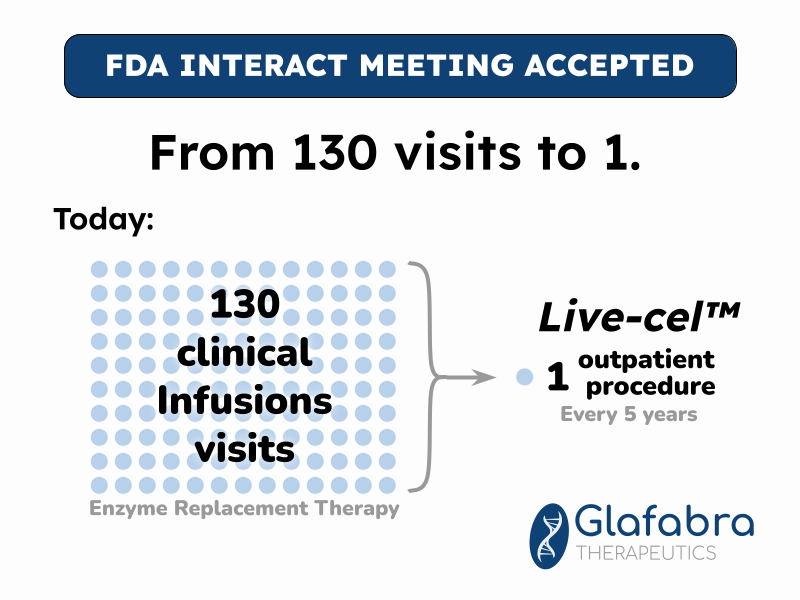
Live-cel gene therapy - 130 clinical visits converted into one
FDA grants Glafabra an INTERACT meeting for GT-GLA-S03, a cell-based gene therapy designed to replace 130 lifetime Fabry infusions with a single procedure.
FDA's acceptance of INTERACT request validates the clinical and manufacturing case built on GT-GLA-S03, with reduced conditioning opening the door to affordable repeat dosing”
— CEO, Dr. Chris Hopkins, PhD, MBA
PARK CITY, UT, UNITED STATES, May 19, 2026 /EINPresswire.com/ -- A High Bar Cleared
The FDA has accepted Glafabra Therapeutics' request for a face-to-face INTERACT meeting on July 16, 2026, to discuss GT-GLA-S03, the company's lead gene therapy candidate for Fabry disease. This is a meaningful regulatory milestone. The INTERACT program gives cell and gene therapy developers direct agency feedback at an early development stage, before pre-IND or IND submission, and acceptance is selective; per the BGTC Playbook (2025), roughly 70% of requests are declined. Feedback from the meeting will directly shape Glafabra's IND submission, targeted for Q1 2027, and is expected to reduce regulatory uncertainty heading into the planned Phase 1/2 trial.
One Treatment. Five Years. A Different Future for Fabry Patients.
Patients with Fabry disease currently rely on enzyme replacement therapy (ERT), which means 26 intravenous infusions every year, for life. That is 130 clinic visits over five years, with treatment schedules dictating how patients live.
GT-GLA-S03 is designed to replace that burden with a single outpatient procedure delivering at least five years of therapeutic benefit. The therapy uses a patient's own cells, genetically modified with a lentivirus to produce the enzyme missing in Fabry disease. Once reintroduced, these cells engraft in the bone marrow and generate white blood cells that travel throughout the body, secreting the missing enzyme. Neighboring cells absorb the enzyme through a process called cross-correction, halting the buildup of toxic lipid metabolites that drive the disease.
Five Years of Human Data Already in Hand
GT-GLA-S03 is not starting from scratch. Five-year data from the FACTS trial (NCT02800070), an investigator-initiated study led by Glafabra co-founders Dr. Jeffrey Medin and Dr. Ronan Foley in Canada, provides the clinical foundation. Five patients followed for five years showed zero product-attributable serious adverse events. Plasma lyso-Gb3, a critical disease biomarker, fell 48% from the no-ERT baseline (p<0.0001, 99% statistical power). Four of five patients kept lyso-Gb3 below the elevated threshold at five years, and four of five received their conditioning regimen as a same-day outpatient procedure. Results have been published in Nature Communications and Clinical and Translational Medicine. GT-GLA-S03 holds FDA Orphan Drug Designation.
A Therapy Built for Every Fabry Patient
GT-GLA-S03 is designed to treat the full Fabry population regardless of GLA variant. Chaperone-based therapies reach only 40% of patients. Roughly 30% of ERT-treated patients develop neutralizing antibodies that blunt their treatment; in FACTS, patients who received GT-GLA-S03 saw those pre-existing antibody responses diminish over time. AAV-based gene therapies face a separate barrier, since pre-existing anti-capsid antibodies exclude roughly one-third of the population. GT-GLA-S03 has no such barrier. It is positioned as the only repeatable, variant-agnostic, antibody-status-agnostic option, and may also serve as rescue therapy for patients who lose gene expression after AAV trials. The non-myeloablative outpatient conditioning with low-dose melphalan is also far easier on patients than busulfan-based regimens.
A Platform, Not Just a Product
The Live-cel manufacturing process extends across lysosomal storage disorders. Glafabra's pipeline includes GT-GAA-S04 for Pompe disease and GT-GBA1-S05 for Gaucher disease, both preclinical and eligible for Orphan Drug and Rare Pediatric Disease Designation. Each could unlock a Priority Review Voucher, which have consistently sold for over $100 million (recent transactions include Zevra, Acadia, and PTC at $150 million, Abeona at $155 million, and Ipsen at $158 million). The Rare Pediatric Disease PRV program was reauthorized in February 2026 through September 2029 under the Consolidated Appropriations Act. The Live-cel platform has potential reach across roughly 70 lysosomal storage disorders and 900 known enzyme deficiency disorders.
About Glafabra Therapeutics
Glafabra Therapeutics is a pre-clinical stage cell and gene therapy company developing the Live-cel platform for lysosomal storage disorders. The lead program, GT-GLA-S03, targets an IND filing in Q1 2027 and first patient enrollment in Q3 2027 at University of Utah Health.
Chris Hopkins
Glafabra Therapeutics
+1 801-631-9114
email us here
Legal Disclaimer:
EIN Presswire provides this news content "as is" without warranty of any kind. We do not accept any responsibility or liability for the accuracy, content, images, videos, licenses, completeness, legality, or reliability of the information contained in this article. If you have any complaints or copyright issues related to this article, kindly contact the author above.
