

USD 108.50 Billion Wireless Connectivity Market Expected to Hit USD 297.29 Billion by 2035
Wireless Connectivity Market
Wireless Connectivity Market Size, Share and Research Report By Technology (Wi-Fi, Bluetooth, Ultra-Wideband (UWB), Zigbee / Thread / Others)
Wireless Connectivity Market is accelerating as businesses and consumers demand faster, more reliable, and seamless communication across connected devices.”
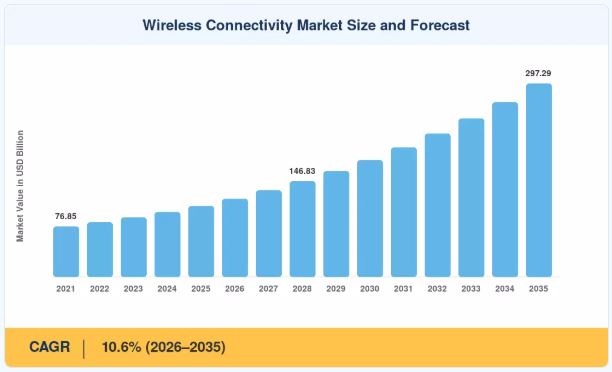
SEOUL, SEOUL, SOUTH KOREA, August 7, 2026 /EINPresswire.com/ -- The Global Wireless Connectivity market stood at USD 108.50 billion in 2025 and is projected to climb from USD 120.00 billion in 2026 to USD 297.29 billion by 2035, registering a CAGR of 10.6% across the forecast window. Two structural forces anchor this trajectory: the full release of the 6 GHz band across North America and parts of Europe, which has unlocked roughly 1,200 MHz of contiguous spectrum for next-generation Wi-Fi, and the parallel densification of private 5G networks inside manufacturing campuses, where deterministic latency justifies premium module pricing. — Market Research Future (MRFR)
The market's 10.6% CAGR reflects the convergence of IoT device proliferation (~2.1% CAGR impact), 5G standalone and private-network rollout (~2.0%), Wi-Fi 7 standard adoption (~1.8%), and automotive V2X mandates (~1.5%) accelerating across the world's largest device-manufacturing and connected-vehicle markets simultaneously.
Multi-radio modules that integrate Wi-Fi 7, Bluetooth 5.4, and ultra-wideband on a single die are replacing legacy single-radio designs based on standalone Bluetooth or 2.4 GHz Wi-Fi, reducing board area by up to 40% and cutting power budgets below 1.5 W per module. Automakers alone are predicted to integrate an average of 18 wireless endpoints per car by 2028, up from 11 in 2024, as V2X regulations and in-cabin experience platforms proliferate. Asia-Pacific dominates the market with an estimated 36.8% share, driven by contract electronics manufacturing clusters in China, Vietnam, and India.
The Middle East and Africa region is expected to record the fastest CAGR of 12.9% through 2035 as 5G fixed-wireless-access deployments spread smart-city backhaul throughout the Gulf Cooperation Council states. Europe holds the second-largest share at roughly 22.3%, driven by Industry 4.0 initiatives in the Nordic countries and automotive OEM demand in Germany. Wireless connectivity is becoming foundational infrastructure across every connected device category rather than a discrete feature line item as radio integration and spectrum access mature.
Get Full PDF Sample Copy of Report: (Including Full TOC, List of Tables & Figures, Chart) @
https://www.marketresearchfuture.com/sample_request/2148
➤ How Significant Is the Wireless Connectivity Market's Growth?
The wireless connectivity market's trajectory from USD 108.50 billion in 2025 to a projected USD 297.29 billion by 2035 represents nearly a three-fold expansion over the forecast decade, reflecting the structural shift from single-radio, single-purpose modules toward integrated multi-protocol combo chipsets embedded in nearly every connected device category. The market's 10.6% CAGR is anchored in a spectrum-and-silicon investment cycle where 6 GHz band commercialization, private 5G enterprise deployment, and automotive V2X mandates are all converging to push wireless radios from optional add-ons to mandatory platform components.
Wi-Fi commanded a 46.2% revenue share in 2025 the largest single technology segment driven by enterprise access-point refresh cycles and consumer router upgrades to Wi-Fi 6E and Wi-Fi 7 standards, while ultra-wideband is on track for a 13.4% CAGR through 2035, underpinned by precision-location use cases in automotive digital-key and industrial asset-tracking applications. Consumer electronics accounted for 39.8% of 2025 spending, the largest end-user category, reflecting embedded connectivity in smartphones, tablets, smart speakers, and gaming peripherals, though the automotive vertical is forecast to expand at a 12.6% CAGR through 2035 as connected and autonomous driving platforms proliferate.
➤ What Does the Future Hold for the Wireless Connectivity Market?
IoT device proliferation contributes approximately 2.1 percentage points to the wireless connectivity market's CAGR the single highest driver impact. The global ecosystem of IoT-connected devices is expanding rapidly, with projections indicating the installed base will exceed 26 billion units by 2030, and this widespread integration across healthcare, smart manufacturing, and automotive sectors requires dedicated wireless radio hardware for every sensor and actuator, sustaining persistent chipset demand.
5G standalone and private-network rollout contributes approximately 2.0 percentage points to the CAGR, establishing enterprise industrial connectivity as a primary near-term demand source. The private 5G network market is experiencing rapid expansion, with projections indicating a valuation exceeding USD 24 billion by 2030 as manufacturing, logistics, and mining sectors deploy dedicated 5G cells integrated with edge computing to achieve ultra-low latency. Wi-Fi 7 standard adoption adds a further 1.8% to the CAGR as the 802.11be standard leverages 6 GHz spectrum and multi-link operation to deliver the multi-gigabit throughput and ultra-low latency required for enterprise-grade wireless reliability.
The next product generation is shifting from discrete single-radio chips toward AI-at-the-edge wireless architectures that collapse the boundary between connectivity and computation. Qualcomm's AI Engine and MediaTek's APU roadmap both embed neural-processing units alongside Wi-Fi and Bluetooth radios on a single SoC, enabling real-time anomaly detection, voice-wake, and sensor-fusion without cloud round-trips, and by 2030 an estimated 65% of new enterprise access points will ship with integrated edge-AI accelerators.
Non-terrestrial network standards finalized in 3GPP Release 17 are also enabling satellite-terrestrial convergence, with SpaceX, Amazon Kuiper, and AST Space Mobile targeting direct-to-device service by 2027 a capability that will expand the addressable footprint of the wireless connectivity market into maritime, aviation, and rural corridors that remain uneconomical for terrestrial infrastructure today.
Get access to the full description of the report @
https://www.marketresearchfuture.com/reports/wireless-connectivity-market-2148
➤ Who Are the Key Players in the Wireless Connectivity Market?
The wireless connectivity market exhibits medium concentration, with the top five vendors accounting for an estimated 52–58% of global chipset and module revenue, and Qualcomm and Broadcom collectively holding roughly one-quarter of the total market share. Yet the long tail of regional module assemblers particularly in Shenzhen, Taipei, and Bengaluru keeps the competitive structure moderately fragmented, with strategic differentiation increasingly centered on integration density and software-defined configurability. MRFR identifies the following key participants with estimated revenue share ranges:
Qualcomm (~9–12% share) - a vertically integrated leader providing FastConnect Wi-Fi 7, Bluetooth, and UWB combo SoCs alongside Snapdragon automotive platforms, spanning connectivity IP from modem design through reference-design delivery to OEM partners.
Broadcom (~8–11% share) - an enterprise and infrastructure specialist providing BCM Wi-Fi 7 chipsets, enterprise access-point silicon, and Bluetooth audio SoCs, with broad OEM reach across networking equipment manufacturers.
Intel Corporation (~5–8% share) - a PC-centric connectivity provider offering Wi-Fi 7 M.2 modules including the BE200 and BE202, with Thunderbolt-Wi-Fi integration tied closely to the x86 platform ecosystem.
MediaTek Inc. (~7–10% share) - a cost-competitive combo-chip specialist providing the Filogic Wi-Fi 7 platform and Dimensity 5G modems, with particular strength in mid-tier smartphones and consumer router categories.
NXP Semiconductors (~4–6% share) - an automotive and industrial IoT specialist providing UWB Trimension technology, Wi-Fi 6E modules, and automotive radar-connectivity solutions for digital-key and V2X applications.
Infineon Technologies (~3–5% share) - a broad industrial and automotive module provider offering AIROC Wi-Fi and Bluetooth combo chips, PSoC Edge with wireless integration, and the legacy Cypress connectivity portfolio.
Texas Instruments (~3–5% share) - a low-power industrial IoT specialist providing the SimpleLink family spanning Wi-Fi, Bluetooth, and Zigbee/Thread MCUs, with particular strength in building-automation applications.
Murata Manufacturing (~3–4% share) - a module-level miniaturization leader providing compact Wi-Fi, Bluetooth, and UWB modules for mobile and wearable OEMs, serving customers who require board-space-constrained radio integration.
Nordic Semiconductor (~2–3% share) - an ultra-low-power specialist providing nRF54 and nRF53 BLE SoCs alongside Wi-Fi companion ICs and cellular IoT solutions, with strong positioning in Matter-compatible smart-home devices.
Silicon Laboratories (~2–3% share) - a mesh-networking protocol specialist providing xG24 and xG28 multi-protocol SoCs supporting Z-Wave and Matter, targeting smart-home and building-automation deployments.
Strategic competition in the wireless connectivity market is increasingly defined by radio-integration density and software-defined configurability with foundry capacity constraints at advanced process nodes cited as a persistent supply-chain bottleneck alongside spectrum fragmentation across jurisdictions, cybersecurity compliance costs under frameworks such as the EU's NIS2 Directive, and the depth of automotive and industrial design-win pipelines that convert chipset sales into multi-year platform contracts.
➤ What Are the Emerging Trends in the Wireless Connectivity Market?
Several transformational trends are redefining the wireless connectivity market's evolution through 2035:
AI-at-the-Edge Wireless Architectures: On-device AI inference is collapsing the boundary between connectivity and computation, with Qualcomm's AI Engine and MediaTek's APU roadmap both embedding neural-processing units alongside Wi-Fi and Bluetooth radios on a single SoC, enabling real-time anomaly detection and sensor-fusion without cloud round-trips.
Satellite-Terrestrial Convergence: Non-terrestrial network standards finalized in 3GPP Release 17 allow low-earth-orbit satellite constellations to interoperate with terrestrial 5G cores, with SpaceX, Amazon Kuiper, and AST SpaceMobile targeting direct-to-device service by 2027 and expanding coverage into maritime, aviation, and rural corridors.
Sustainability and Energy-Efficient Protocols: The ITU's Green ICT framework targets a 45% reduction in network energy consumption per unit of data traffic by 2030, with Wi-Fi 7's multi-link operation and Bluetooth 5.4's periodic advertising with responses reducing idle current draw by 30–40% compared to predecessor standards.
6G Preparatory Standardization: Pre-standardization research consortia including the EU's Hexa-X-II, Japan's Beyond 5G Promotion Consortium, and the U.S. Next G Alliance are defining sub-THz channel models and reconfigurable intelligent surface architectures ahead of commercial 6G deployment expected around 2032.
Connectivity-Data Monetization: Automakers and smart-building operators are exploring subscription-based models that leverage anonymized wireless telemetry as recurring revenue streams, with BMW's ConnectedDrive platform generating over EUR 400 per vehicle over the ownership lifecycle in digital-service revenue.
Buy Full Research Report:
https://www.marketresearchfuture.com/checkout?currency=one_user-USD&report_id=2148
➤ How Is the Wireless Connectivity Market Segmented?
The wireless connectivity market report provides a comprehensive segmentation framework:
By Technology: Wi-Fi, Bluetooth, Ultra-Wideband (UWB), Zigbee / Thread / Others
By End-User Industry: Consumer Electronics, Automotive, Industrial / Manufacturing, Healthcare, Others (Retail, Energy, Defense)
By Frequency Band: Sub-1 GHz, 2.4 GHz, 5 GHz, 6 GHz
By Device Type: Smartphones & Tablets, Smart Home Devices, Wearables, Industrial Equipment, Others (PCs, Gaming, Automotive IVI)
By Region: North America, Europe, Asia-Pacific (36.8%), South America, Middle East & Africa (12.9% CAGR)
➤ What Are the Regional Insights from the Wireless Connectivity Market?
Asia-Pacific leads the wireless connectivity market with a 36.8% share in 2025, with China commanding 41.3% of regional revenue through domestic SoC design and consumer electronics scale led by HiSilicon, Unisoc, and expanding fabs from SMIC. India is posting a 12.4% CAGR within the region through its BharatNet program and the Production-Linked Incentive scheme worth INR 760 billion, attracting Foxconn, Tata Electronics, and Dixon Technologies to localize wireless module assembly near Chennai and Noida. Japan contributes USD 5.89 billion through automotive OEM connectivity platforms, South Korea holds 10.2% of regional share through 5G SA densification and semiconductor leadership, and ASEAN is growing at a 10.9% CAGR through factory-floor wireless retrofits in Vietnam and Thailand.
North America contributes USD 30.92 billion to the wireless connectivity market in 2025, with the United States commanding 78.4% of regional revenue as the FCC's 2020 decision to open the entire 6 GHz band for unlicensed use delivered a first-mover advantage that stimulated early Wi-Fi 6E and now Wi-Fi 7 enterprise deployments. Canada contributes 12.8% of regional revenue through smart-grid and mining-sector connectivity following ISED's conditional 6 GHz release in 2023, and Mexico adds 8.8% through nearshoring-driven factory wireless upgrades in Nuevo León and Jalisco.
Europe accounts for 22.3% of global wireless connectivity market share, with Germany posting a 10.8% CAGR through campus-network licenses for industrial OEMs following the Bundesnetzagentur's issuance of more than 260 licenses by early 2025. The United Kingdom contributes USD 4.62 billion through smart-building and NHS digital-health programs channeling GBP 2.1 billion into connected diagnostics, France holds 14.2% of regional revenue through automotive tier-supplier connectivity integration, Italy contributes 9.7% through smart-meter rollout under ARERA mandates, and the Nordic countries are growing at a 10.4% CAGR through industrial IoT in forestry, mining, and maritime applications.
The Middle East & Africa is the fastest-growing region in the wireless connectivity market, projected to register a 12.9% CAGR through 2035. Saudi Arabia commands 31.7% of regional revenue through NEOM and Vision 2030 smart-city initiatives, with the Public Investment Fund's 2024 disclosure indicating NEOM alone is expected to embed more than 500,000 wireless access points. The UAE is growing at an 11.5% CAGR through 5G fixed-wireless access and hospitality-sector Wi-Fi upgrades, having released mmWave spectrum in the 26 GHz and 28 GHz bands. South America holds 5.2% of global revenue, with Brazil commanding 62.5% of regional share following Anatel's 2021 3.5 GHz and 26 GHz 5G auction that generated BRL 47 billion in commitments now translating into fixed-wireless-access CPE shipments.
➤➤➤ Regional & Country-Level Reports by Market Research Future:
Italy Wireless Connectivity Market -
https://www.marketresearchfuture.com/reports/italy-wireless-connectivity-market-55120
Europe Wireless Connectivity Market -
https://www.marketresearchfuture.com/reports/europe-wireless-connectivity-market-55121
Canada Wireless Connectivity Market -
https://www.marketresearchfuture.com/reports/canada-wireless-connectivity-market-55119
France Wireless Connectivity Market -
https://www.marketresearchfuture.com/reports/france-wireless-connectivity-market-55118
China Wireless Connectivity Market -
https://www.marketresearchfuture.com/reports/china-wireless-connectivity-market-46970
Brazil Wireless Connectivity Market -
https://www.marketresearchfuture.com/reports/brazil-wireless-connectivity-market-55124
Spain Wireless Connectivity Market -
https://www.marketresearchfuture.com/reports/spain-wireless-connectivity-market-55123
Mexico Wireless Connectivity Market -
https://www.marketresearchfuture.com/reports/mexico-wireless-connectivity-market-55122
➤➤➤ Industry Analysis Reports by Market Research Future:
Risc V Tech Market-
https://www.marketresearchfuture.com/reports/risc-v-tech-market-38126
Consumer Durable Loans Market-
https://www.marketresearchfuture.com/reports/consumer-durable-loans-market-40608
Sagar Kadam
Market Research Future
+ +1 628-258-0071
email us here
Legal Disclaimer:
EIN Presswire provides this news content "as is" without warranty of any kind. We do not accept any responsibility or liability for the accuracy, content, images, videos, licenses, completeness, legality, or reliability of the information contained in this article. If you have any complaints or copyright issues related to this article, kindly contact the author above.
