

Scaling AI Infrastructure with Custom Data Center Liquid Cooling CDU Solutions from EXTRCOOL
Navigating CDU Selection: Air-to-Liquid vs. Liquid-to-Liquid Architectures
Selecting the appropriate CDU architecture requires carefully aligning the thermal density of the IT equipment with the existing mechanical infrastructure of the building. Modern direct-to-chip liquid cooling deployments rely primarily on two structural configurations: air-to-liquid and liquid-to-liquid units.
A.Air-to-Liquid CDUs
Air-to-liquid systems transfer thermal energy directly into the surrounding room air through internal heat exchangers and variable-speed fans. These units are ideal for facilities that lack dedicated chilled water piping or central secondary fluid loops, offering a rapid path to deployment.
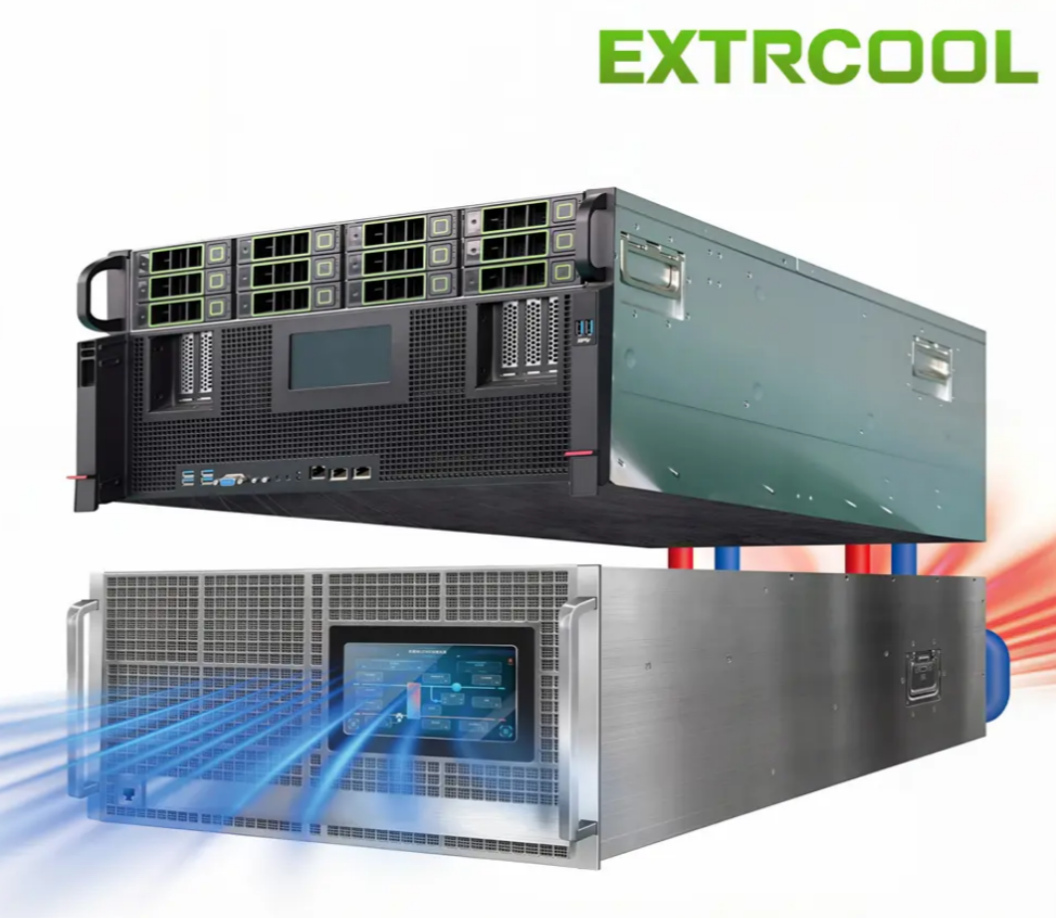
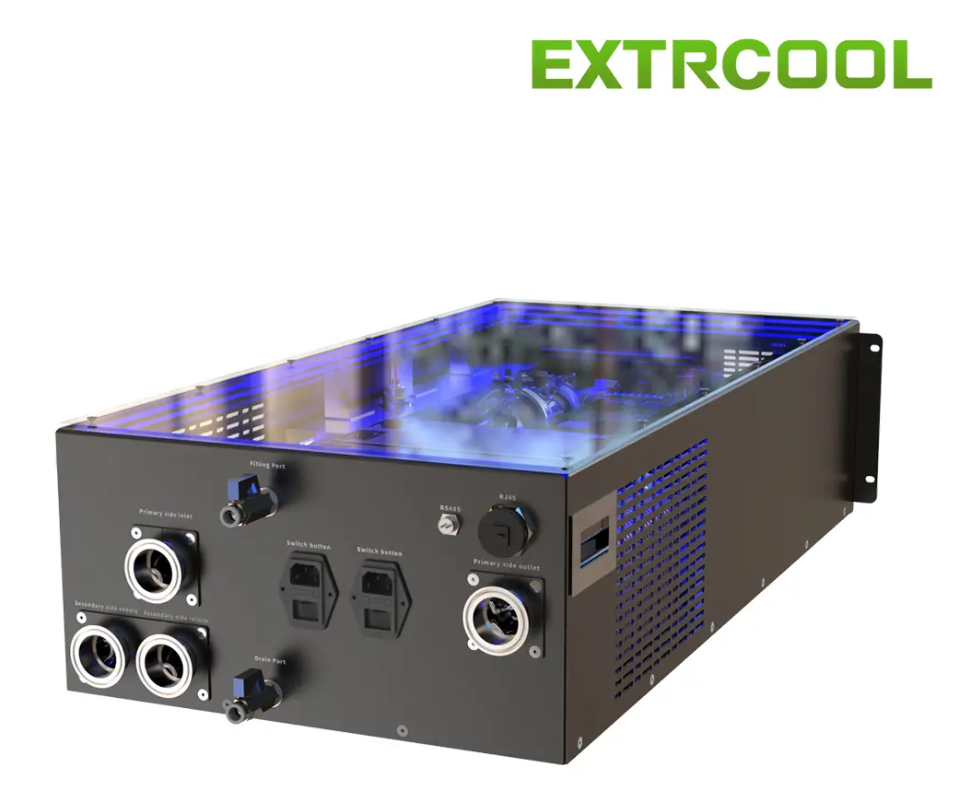
Rack-Mounted 4U/6U Units: Designed for direct integration into standard 19-inch IT racks, these compact CDUs manage heat loads between 10 kW and 30 kW. They enable operators to deploy liquid cooling at specific high-density racks without modifying overall room infrastructure or disruptive construction.
Floor-Standing Cabinets: Built for higher density rows, standalone air-to-liquid cabinet units deliver cooling capacities up to 100 kW. These cabinets combine redundant pumps, internal heat exchangers, and intelligent controls to support localized high-density cluster expansion without requiring extensive plumbing.
B.Liquid-to-Liquid CDUs
Where central facility water or dedicated external liquid cooling loops are present, liquid-to-liquid CDUs deliver maximum thermal capacity, precise temperature control, and exceptional heat transfer efficiency.
Stainless Steel Heat Exchangers: Utilizing corrosion-resistant 316L stainless steel brazed plate heat exchangers, these units isolate primary facility water from secondary server loops. This physical separation protects sensitive cold plate microchannels from contamination while maintaining clean, predictable internal fluid circuits.
Modular Secondary Circuits: Featuring modular pump skids and active dual-pump redundancy, liquid-to-liquid CDUs support thermal loads ranging from 100 kW to over 1 MW per cabinet. Built-in differential pressure regulation maintains steady fluid delivery to every compute node while preventing harmful cavitation.
Critical Dimensions of Engineering Customization
Standard off-the-shelf cooling equipment frequently requires physical compromises when integrated into non-standard rack geometries, varying fluid chemistries, or tight floor plans. Custom data center liquid cooling CDU engineering eliminates these operational bottlenecks by adjusting mechanical interfaces, fluid routing, and digital control parameters to meet explicit site demands.
EXTRCOOL approaches system customization across three primary physical and operational dimensions:
1.Manifold Integration: Custom manifold arrangements are built to match specific quick-disconnect interfaces, rack pitch dimensions, and port layouts. This tailored fit reduces internal flow resistance, maintains equal fluid distribution across all server blades, and eliminates unwanted pressure drops within the secondary loop.
2.Piping Layout Optimization: Customized secondary liquid cooling pipe arrangements accommodate both top-of-rack overhead routes and under-floor piping networks. Utilizing tailored stainless steel distribution headers eliminates mechanical stress on server chassis connectors and avoids dangerous bend radiuses that restrict coolant flow.
3.Intelligent Flow and Differential Pressure Control: Custom control firmware monitors supply temperatures, line pressure differentials, and real-time flow rates. Variable-frequency drives adjust pump speeds dynamically to mirror instantaneous compute spikes, preserving stable thermal boundaries during heavy AI training cycles.
Operational Efficiency and Performance Metrics
Optimizing fluid-to-fluid heat exchange yields measurable, long-term improvements in facility operational expenditure. By isolating primary and secondary fluid loops and delivering precise coolant supply temperatures directly to direct-to-chip cold plates or rear-door heat exchangers, a custom data center liquid cooling CDU minimizes fan power draw and pump energy consumption. Dedicated supply temperature management eliminates thermal throttling across high-frequency processing units, allowing chips to maintain maximum clock speeds under continuous heavy utilization.
Field deployments indicate that incorporating a tailored data center liquid cooling CDU can lower overall facility Power Usage Effectiveness (PUE) to below 1.05. Substituting compressor-driven air chillers with optimized liquid heat transfer delivers overall energy savings exceeding 40 percent. Over multi-year operating lifecycles, these gains significantly decrease operational expense, reduce environmental impact, stabilize component longevity, and maximize available power capacity for actual compute hardware rather than auxiliary cooling infrastructure.
Implementation Guidelines for Scalable Liquid Cooling Deployment
Successfully transitioning a facility to high-density liquid cooling requires a structured deployment protocol that aligns physical rack infrastructure with fluid distribution systems. Initial steps involve auditing rack-level heat outputs, verifying floor load ratings, and mapping space constraints to choose between rack-mounted or standalone cabinet architectures. Operations teams must ensure that all secondary distribution manifolds, flexible hoses, and quick-disconnect fittings use corrosion-resistant materials compatible with chosen dielectric fluids. Integrating CDU control units into central Data Center Infrastructure Management platforms using standard Modbus or SNMP protocols enables real-time telemetry, automated pressure adjustments, and rapid leak detection.
Furthermore, selecting hardware that complies with recognized international certifications—including RoHS, CE, UL, and CCS—guarantees long-term structural integrity and safe operation under continuous high pressure. Extrcool Industry Limited supplies engineered cooling hardware supported by global manufacturing resources and comprehensive technical support. With extensive project experience spanning data centers, energy storage installations, and industrial thermal management, EXTRCOOL helps operators scale high-density compute capacity efficiently.
To review product specifications and advanced liquid cooling configurations, please visit https://www.extrcool.com/
Extrcool Industry Limited
Extrcool Industry Limited
+86 136 1255 8238
email us here
Visit us on social media:
Facebook
Legal Disclaimer:
EIN Presswire provides this news content "as is" without warranty of any kind. We do not accept any responsibility or liability for the accuracy, content, images, videos, licenses, completeness, legality, or reliability of the information contained in this article. If you have any complaints or copyright issues related to this article, kindly contact the author above.
